Download PDF
Download Slides
Why did we write this paper?
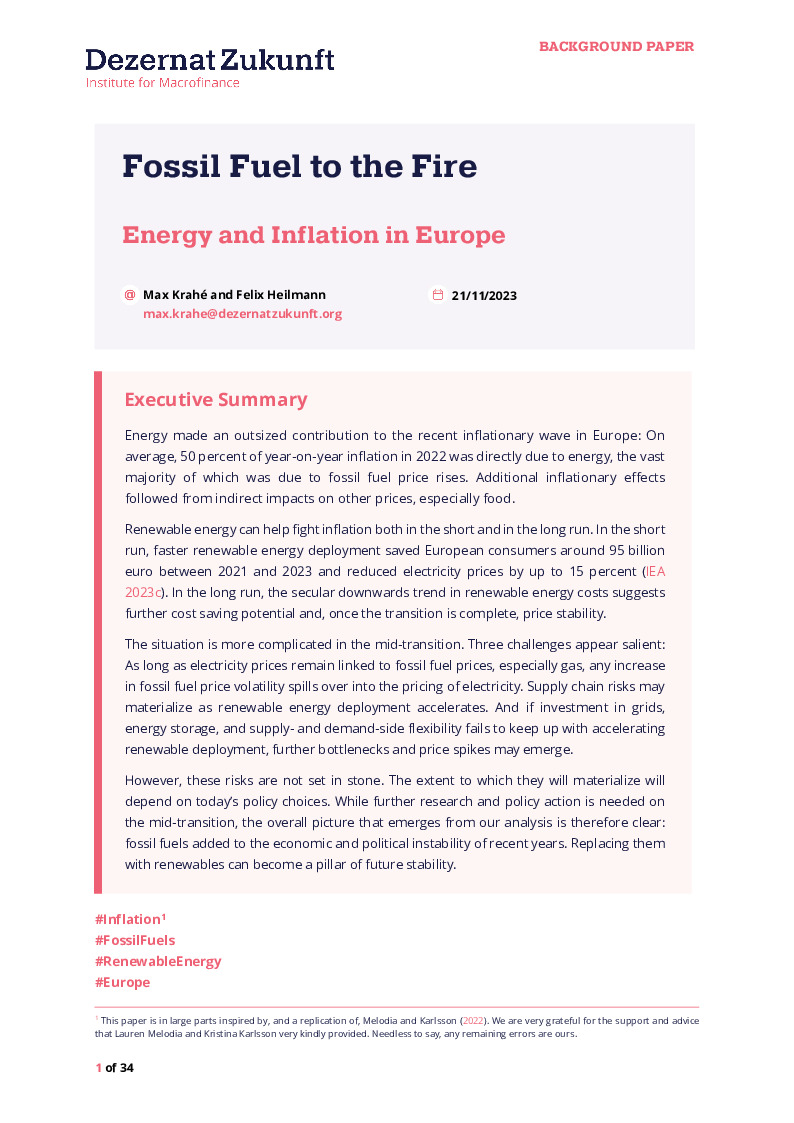
Over the last three years, Europe (and much of the world) experienced a wave of double-digit inflation. This wave is now receding; but since we face an uncertain future, it is important to take stock and draw lessons.
We decided to zoom in on inflation for two reasons: first, inflation is the main driver of higher central bank interest rates. Managing inflation well — which requires understanding its causes — helps to keep interest rates low. This, in turn, provides a supportive environment for public finance and private investment.
Second, inflation is often seen as a socially disruptive phenomenon. Although research has shown that, at low double digits, it is macroeconomically harmless, its social and political effects can be significant. To preserve social cohesion and political agency, a good understanding of inflation is key.
What did we learn?
We learned that fossil fuels were indeed the main driver of the recent wave of European inflation. They had a large direct effect on the harmonised index of consumer prices; and the impact of fossil prices on electricity- and food prices created large indirect effects. Both their direct and their indirect effects would have been even larger, had it not been for anti-inflationary fiscal measures. These, however, came at a cost.
We also saw that renewable energy was an important dampener in the short run, reducing EU wholesale electricity prices by up to 15 percent and saving European consumers just shy of 100 billion euro; and that it can be an important stabiliser in the long run, offering both lower and more stable (on macroeconomic time scales) prices.
Finally, we learned that between the short and the long run lie certain challenges: the risks of the “mid-transition” must be successfully navigated to reap the full stabilisation potential of renewable energies. Managing these risks appears well within our grasp; but further research is needed to get a clear understanding of these challenges, as well as to identify the precise policies required to handle them.
Um über unsere weiteren Veröffentlichungen auf dem Laufenden zu bleiben, abonniert gerne unserenNewsletter.