The US government has barred foreigners from using Anthropic’s most powerful AI model. AI researchers and economists warn of Europe’s dependence on the US models. Project Europe 2031 even sees the continent as a vassal state of the US. To prevent that, Europe should finally build its own AI foundation models and invest as much as possible in computing power. The EU Commission is already attempting the latter.
We think that’s wrong. Why?
The business model of American AI needs the European market
The US cannot simply cut off Europe’s access to AI. In case you are wondering whether we have overlooked the restrictions on the use of Anthropic’s latest model, Mythos: what America can do is delay the release of the most capable models and thereby limit access to certain capabilities; they can do so until an open-source model offers the same capabilities. Access to the most capable models is of limited relevance for most business applications though. It mainly matters for cybersecurity and research.
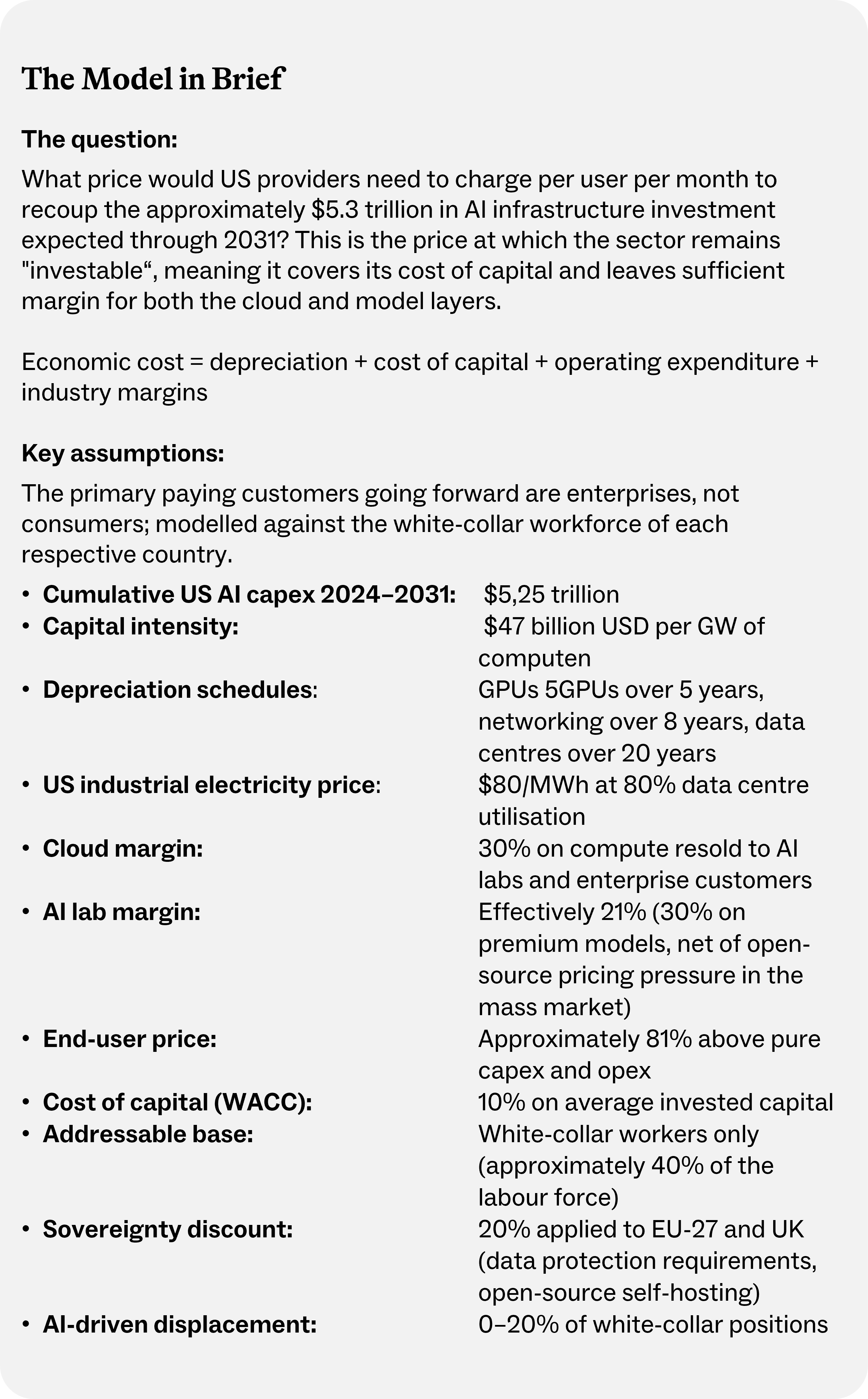
It is something else entirely if the US were to restrict the availability of American models in general. We assume such a step is only possible if it does not break the business model of AI labs and hyperscalers, so we ran the numbers. Such calculations are always fraught with uncertainty and require numerous assumptions, see the box below the chart. But they can give a sense of the magnitudes involved.
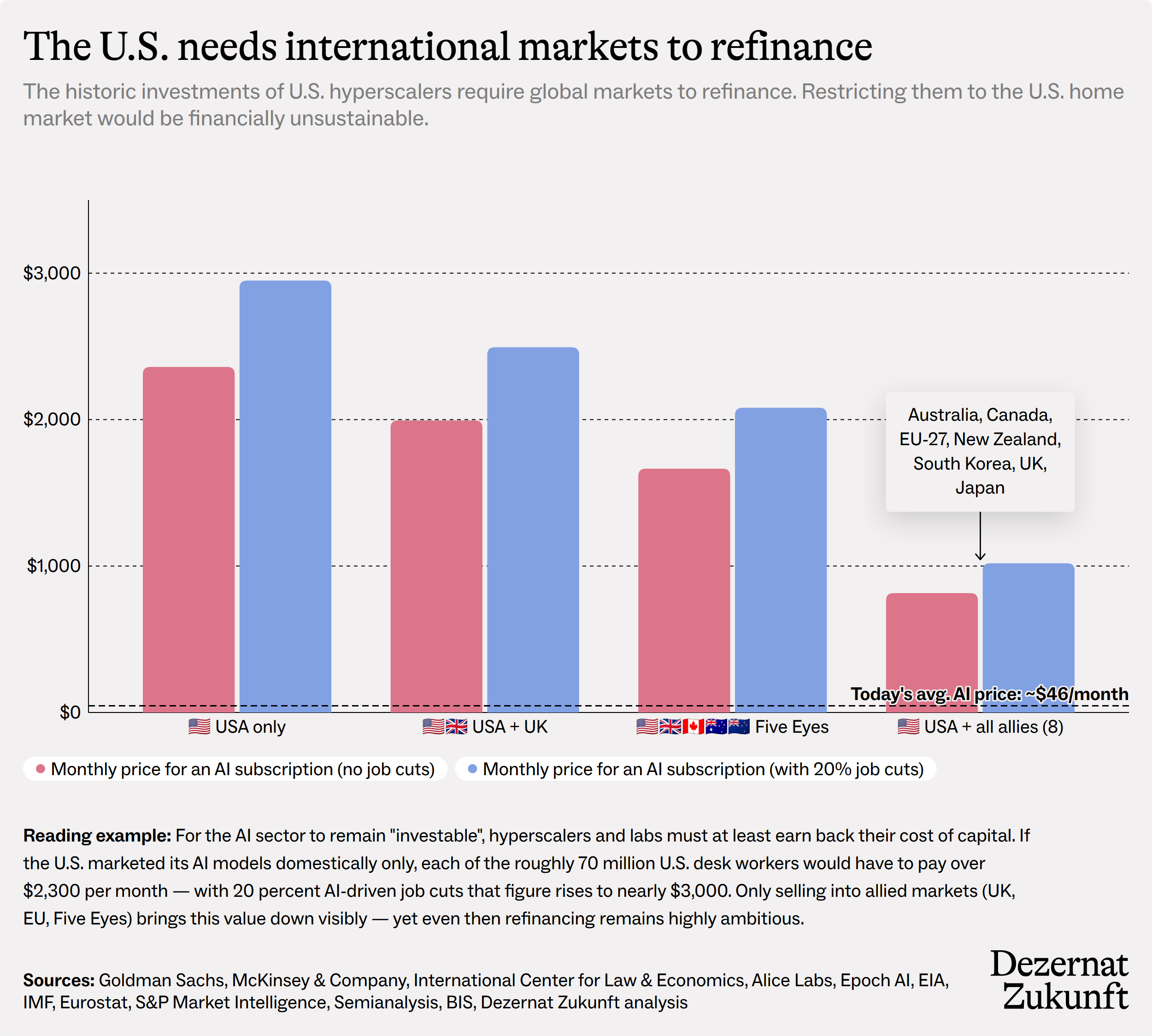
Today the AI labs earn an average of $46 a month per person. In our baseline scenario, we assume that the US models are available in all major industrialised nations that also collaborate with America on security policy. We also make the simplifying assumption that AI labs earn money by selling AI to all white-collar workers or their respective employers. In the baseline scenario, AI labs can sell to 220m white-collar workers. To generate their expected return, the AI labs would have to make around $800 a month from each of these white-collar workers. That already looks hard to achieve. If the AI labs were active only in the US, they would have to generate $2,400 a month from each and every one of the 70m American white-collar workers. If 20% of the jobs are cut for efficiency reasons, it is even $3,000 a month per capita. We consider that implausible. American AI labs urgently need the European market for their business model to work out.
The potential to monetise the models is limited
AI optimists may object that the AI labs could charge significantly more once they really replace workers en masse. In that scenario, the AI labs would not need the European market. But such pricing power is hardly plausible as long as open-source models are chasing the US models. On average, the best open-source models lag four months behind the best foundation models. Yet a million tokens (the units into which a model breaks down text) cost only 24 cents with the open-source model DeepSeek V4 Pro, versus $1.60 with Claude Opus 4.8 (as of 18th of June 2026) — almost seven times as much. Anyone who doesn’t need the latest model won’t use it once costs start to matter. Microsoft just announced that, for that reason, it may work with DeepSeek in future. Thus, in Europe, we are focusing on the very part of the AI value chain that is currently under pressure. Models are most likely becoming a commodity.
Project 2031 worries about a darker scenario, one in which both the US and China close their models. Given today’s geopolitical circumstances, little is unthinkable. But this scenario, too, is unlikely: if China ended access to its models, America would likely benefit massively, both commercially and geopolitically. It is therefore unlikely that China would cede ground to the US. More plausible is that both the US and China will use their role as model providers to exert power. For geopolitical reasons, Europe should therefore urgently work on its own power levers. More on that later.
Back to the economic dimension: while Europe indulges in model envy vis-à-vis America, it is missing a key trick: pushing adoption. For AI, that means ensuring enough inference compute for models to be used here. Building such data centres also makes commercial sense, since latency — the delay caused by data transfer — matters for model use. Policymakers should help clear the obstacles to building them. Whether they should also subsidise construction, or even take it on themselves, is less obvious.
Adoption is about affordability and access. It’s no accident that three of the best-known AI innovations are a chatbot (ChatGPT), a personal assistant (OpenClaw) and an AI coding tool (Claude Code). They all have one thing in common: they have massively improved collaboration between humans and machines.
The software accompanying the AI model is far more than just a bit of pretty packaging: at Claude it makes up over 98% of the code. Only 1.6% of Claude’s code interacts with the AI model. SpaceX evidently considers the software layer valuable enough to have just paid $60bn for Cursor (Cursor’s custom model is adapted from Kimi K2.5. It seems a little implausible, that this was the main prize). $60bn is just a little less than the market capitalisation of Deutsche Bank.
While value that can be monetised is created in the software, Europe is about to pump its money into exactly the layer where monetisation is difficult. It plans to build five “AI gigafactories” for €20bn. The gigafactories are not there to run open-source models cheaply — that is, to offer existing AI in Europe as cost-effectively as possible; these gigafactories are meant to train European foundation models. The problem with this: apart from Mistral, no one in Europe develops such foundation models. And Mistral is building its own AI infrastructure. The project has the potential to become the most expensive white elephant of European industrial policy.
AI as a lever of geopolitical power
What remains is the security issue. If the best US models are as dangerous as claimed, the US has a cyberweapon we lack and may be exposed to. And it’s not only the leading models that are a concern. Every model integrated into a company’s workflows can serve as a lever of power for the US government. Europe should therefore urgently develop its own levers of power.
Europe already has such a lever: the machines of the Dutch company ASML are needed to build latest-generation chips. Without chips there is no model training. But relying on this lever alone is risky, above all because ASML itself depends on American supplies. As early as 2019, the USA exerted influence on ASML and prohibited the sale of EUV machines to China.
If Europe wants to keep its seat at the table, it would urgently need to concentrate on expanding its power levers in the value chain — and on doing so where it is strongest: in hardware. That begins with EUV lithography. ASML, Zeiss, Trumpf and other companies are already central players in this field.
The right reflex
What follows from our assessment of the economic and security-policy implications of AI?
Europe should focus less on the infrastructure for model training and more on software that makes AI accessible. Such software is also urgently needed by governments, which currently seem to muddle through. If companies build such tools, governments could stand ready as anchor customers. That might also be one way for the French AI lab Mistral to secure itself a lasting, strong position in international competition.
From a geopolitical perspective, it would be important for Europe to work deliberately to improve its position of power. But not by building models, or gigafactories to train them, years behind the curve. Instead, it should start with hardware, its established strength.
The fight over US foundation models, and over the infrastructure to develop them, is the wrong one. If Europe wants to grow economically and geopolitically stronger in AI, it should bet everything on rapid diffusion and accessibility. Otherwise the most likely scenario will become reality: the big hyperscalers integrate AI into their businesses, and Europe buys their products at high margins, as it always has. That way America slowly grows ever richer and the European member states ever poorer.